The Best Marketers Now Build Systems. So Should Every Leader.
Bessemer's new hiring guide says the AI-native CMO builds systems, not just campaigns. I agree. I came up through design, not marketing, and I run my own work on a team of AI agents. Here is what I would add.
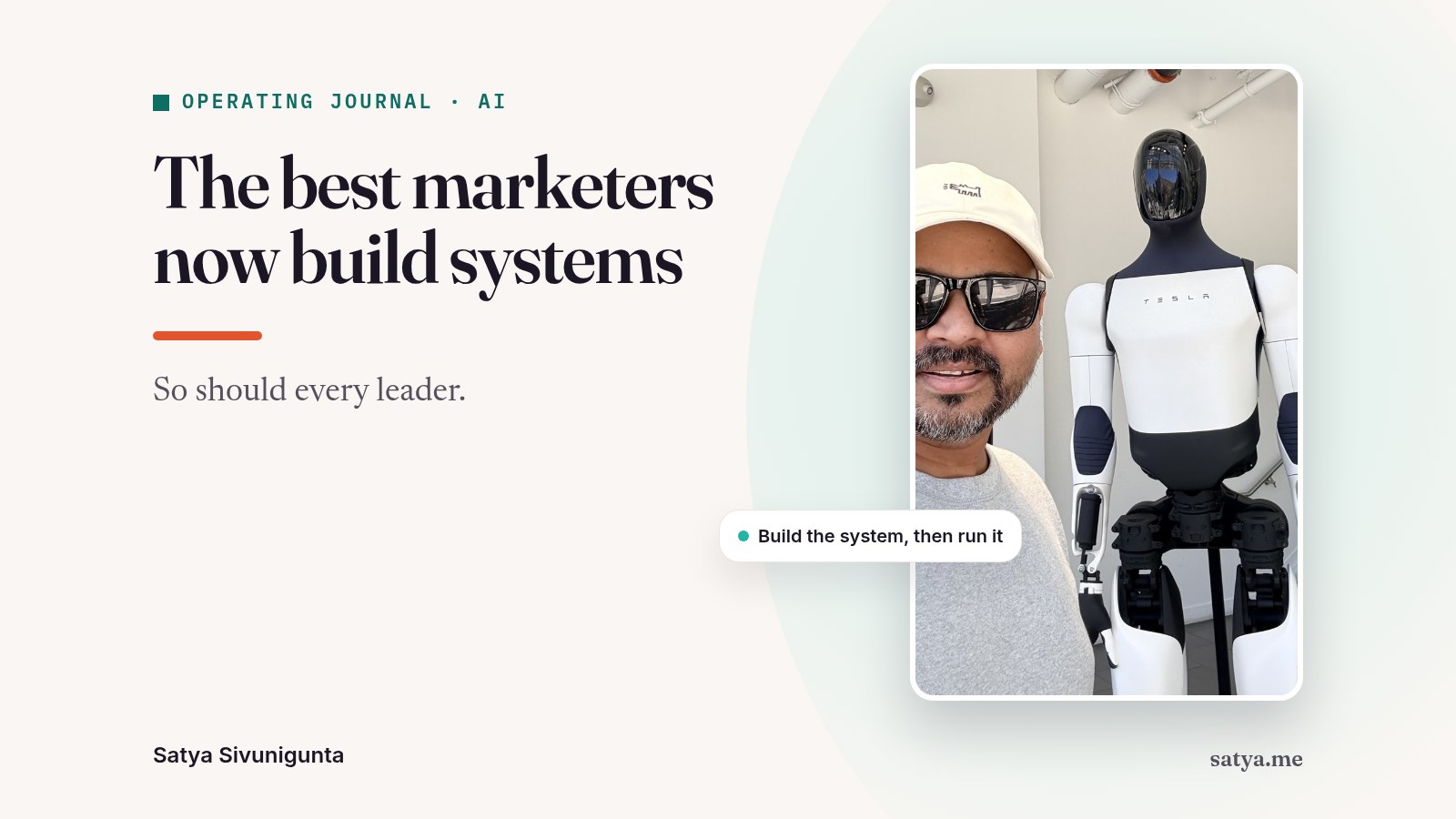
The best marketing leaders are no longer judged by the campaign.
They are judged by the system behind it.
That is the core idea of a new hiring guide from Bessemer Venture Partners. I looked at my own work and saw the same thing.
The short answer: Bessemer says CEOs should look for marketing leaders who build. Leaders who make their own dashboards, automate their own workflows, and can show something they built with AI. I agree with all of it. My one addition is simple. This test is not only for marketers. It is for every leader. The system is the work.
Key takeaways
- The new edge is building systems on top of campaigns, not running more campaigns.
- A daily brief beats a monthly deck. I start every morning with one.
- "Show your work" is the right interview. I would give it to every executive, not only the CMO.
What does Bessemer's guide say?
Bessemer published Talent trends for the AI-native C-suite on Sep 16, 2026. Its talent team surveyed nearly 175 functional leaders across more than 100 portfolio companies. 86% said they were confident AI will meaningfully change how their team operates in the next 12 months.
The marketing section comes with a one-page hiring guide. Eight principles, in short:
- Close the technical gaps with AI to tell the full story of the funnel.
- Look for leaders who build their own intelligence layer.
- Test for workflow automation instinct.
- Choose precision over scale alone.
- Understand AI-native search, also called Generative Engine Optimization.
- Consider non-traditional marketers.
- Make candidates show their work.
- Hire for continuous upskilling, not a fixed skill set.
The report puts the big idea in one line. The AI-native marketer's arbitrage is "systems building on top of traditional campaign management."
Why does an operator care about a CMO guide?
Because I did not come up through marketing.
I started as a product designer, at Nike and Ogilvy, then worked at Microsoft. I led design and digital at Chico's and JCPenney, and later ran digital at Art Van and Conn's. Somewhere on that road, I crossed from design into the P&L.
Marketing always sat next to me. Every campaign I saw land well had a system under it. Clean product data. A site that loaded fast. A promise the warehouse could keep. When the system was weak, the campaign only made the problem louder.
So when Bessemer says CEOs are looking at marketers who "come up through product, operations, or other technical roles," I am not surprised. That path trains you to see the system first.
What is an intelligence layer, in plain words?
It is a report that watches the numbers every day and tells you what changed.
Bessemer says AI now lets leaders "track every performance indicator across the funnel continuously, rather than periodically." Kim Caldbeck, one of their operating advisors, says her first move in a new org "would be to build an AI-powered intelligence report that watches every marketing metric." It "sends a daily summary of trends, outliers, and areas that need attention."
I run a version of this for my own work. I don't have one AI assistant. I have an AI org chart. One agent is my chief of staff. Each morning it reads my mail and calendar and writes a short brief. Only the things that need me today.
It is not a marketing dashboard. But the idea is the same. Do not wait for the monthly deck. Let the system tell you each morning.
What does workflow automation instinct look like?
It looks like a habit. You notice the work you repeat, and you stop doing it by hand.
Bessemer's test: ask which workflows eat the most manual time, and how the leader would automate them end to end.
My rule for this is small. When I correct the same thing twice, it becomes a written rule. I write the fix into that agent's instructions, and the next run follows it.
That is how my content studio works. One agent drafts and prepares my Shorts and essays. Each lesson it learned the hard way is now a line in a checklist, and nothing goes out without my yes. The work wrote that checklist, one fix at a time.
What changes when AI does the searching?
Bessemer puts it plainly: "Discovery is no longer mediated exclusively by traditional search and SEO." People ask Perplexity, Google's AI Overviews, and AI agents. Those tools read your site and decide what to say about you.
I use my own site as a small test bed for this. On satya.me, each essay ends with a short FAQ that answers real questions in plain words. The site has an llms.txt file, a simple page that tells AI tools who I am and what is here. And I let the AI search crawlers in on purpose.
I have not measured what this moves yet, so I won't give you a number. More on this shift in your next customer may be an AI agent.
Why is "show your work" the best test?
Because a demo shows you who made the decisions.
Bessemer tells CEOs to "ask finalists to do a product demo on something they personally built via AI." Then "probe them for where they made the technical decisions versus where they delegated them."
This is my favorite part. Here is my operator twist. I would not stop at the CMO.
Ask every leader to show their work. The finance leader. The operations leader. The head of product. The head of sales. Ask each one four questions:
- What did you build or rebuild with AI this quarter?
- What did you decide yourself?
- What did you hand off?
- How did you check that it worked?
The last one matters most. Every report from my agents must say what was checked against the real source, and what could not be checked. "Done" is not a fact. A live page is a fact.
A leader who built the system can explain it. A leader who only describes it often did not build it.
How do you hire for learning speed?
Bessemer's last principle is about velocity. They want "the aptitude and appetite to upskill continuously with every new model push."
I agree. The tools change every few months. The skill that lasts is trying a new tool on a real problem this week, not next quarter. I keep two workbenches next to my agents for that: Grok CLI for coding and data, and Claude for research and design.
But speed alone is not the point. Speed with rules is. Anything that leaves the building, or cannot be undone, waits for a person's yes.
What would I add to the guide?
Four small things.
- Run the demo for every seat. Not only marketing.
- Ask what the system does when the leader is away. If it stops, it was a person, not a system.
- Ask for the rules, not just the results. Which rule did they write after a mistake?
- Check the checks. Ask how they know a number is true.
Bessemer says the best marketers now build systems. I would go one step further. So do the best leaders of any kind.
From designer to operator, I keep learning the same lesson. The system is the work.
FAQ
What is an AI-native CMO? A marketing leader who builds with AI, not only one who manages campaigns. They build their own dashboards, automate their own workflows, and can show what they made.
What is the "show your work" test for executives? Ask a finalist to demo something they built with AI. Then ask which technical decisions they made and which they handed off.
What is Generative Engine Optimization (GEO)? Making your brand easy for AI search tools to find, read, and describe correctly. Plain answers and clean data help.
Can a CMO come from outside marketing? Yes. Bessemer says CEOs are increasingly considering non-traditional marketers who come up through product, operations, or other technical roles.
One question for you
If your CEO asked you tomorrow to show one thing you built with AI this month, what would you show?
Source: Bessemer Venture Partners, Talent trends for the AI-native C-suite, Sep 16, 2026.
Work with me
An operator's honest read for founders, owners, and CEOs. One sharp session, a full diagnosis, or a fractional seat.