I Don't Have an AI Assistant. I Have an AI Org Chart.
I staff AI agents the way I staff a team: clear roles, one front door, a morning brief, and written rules for what each agent may do alone and what needs my yes.
People ask me which AI assistant I use.
I don't have one. I have an org chart.
The short answer: an AI org chart is a team of AI agents where each one has a single job, a clear boss, and written rules about what it may do alone. One agent takes every request and routes it. Another writes me a brief each morning. The rest run finance, operations, marketing, content, and more. They do the work. I keep the judgment.
I did not plan it this way. I built one agent, then a second, and the second one started stepping on the first. So I did what any operator does when a team grows. I wrote down the roles.
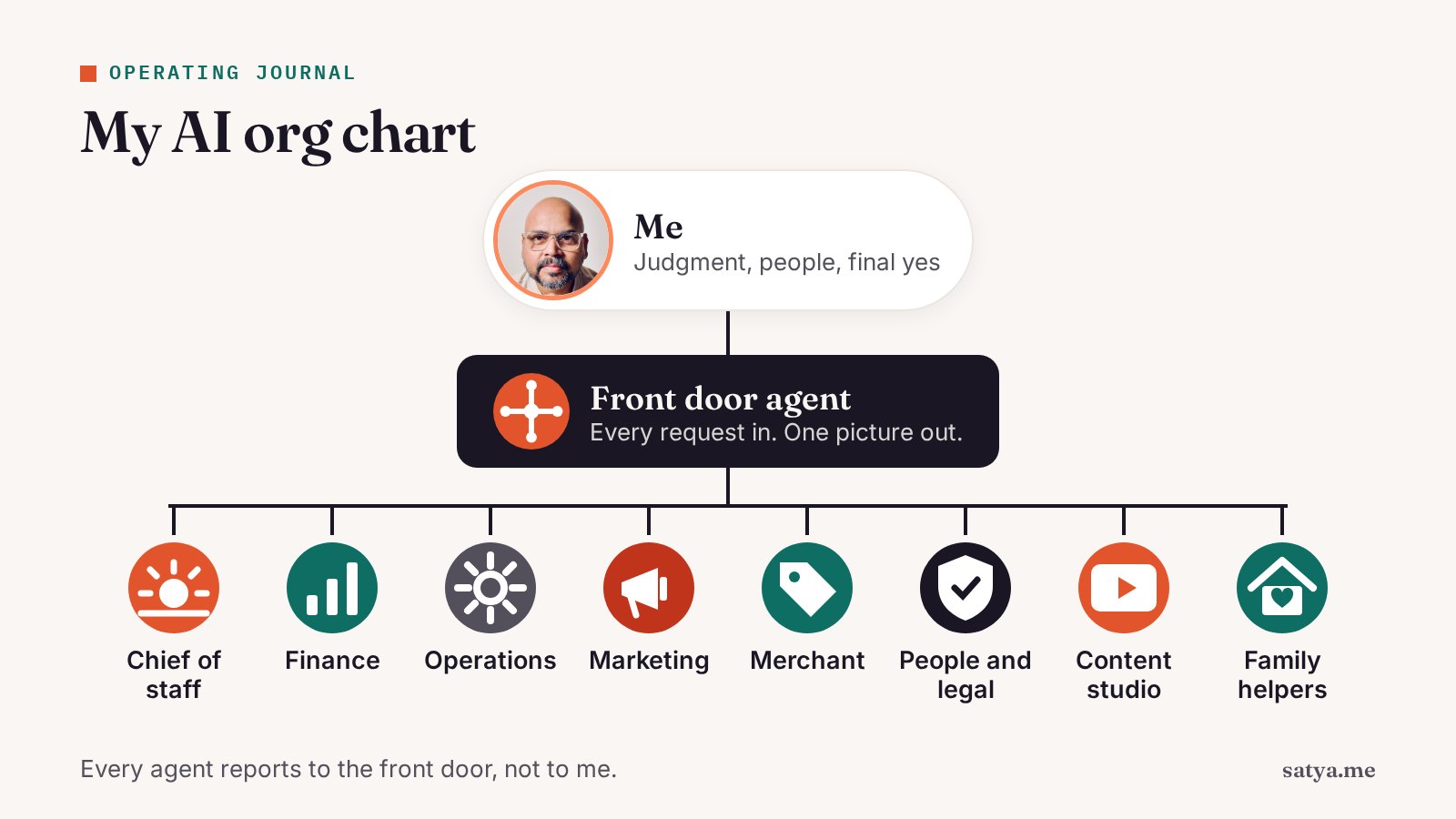
 Me. Every agent on the chart works for one final yes.
Key takeaways
- Give every AI agent one job and one owner, the same way you would staff a person.
- Use one front door. Every request goes to one agent, and it routes the work.
- Write a permission ladder: what an agent may do alone, and what needs your yes.
- When you correct the same thing twice, make it a written rule.
- Keep hands-on building on a workbench. I use Grok CLI and Claude for that.
What is an AI org chart?
It is a map of who does what, where the "who" is an AI agent. Each box has a role, a short job description, the tools it can touch, and the things it must never do.
A recent post about running a small team on scheduled AI tasks made me look at my own setup with fresh eyes. That post is about tools. Mine is about structure. A single assistant has no edges. A team with roles has edges, and edges make work safe to hand off.
Who is on my AI team?
Here is the chart, by role:
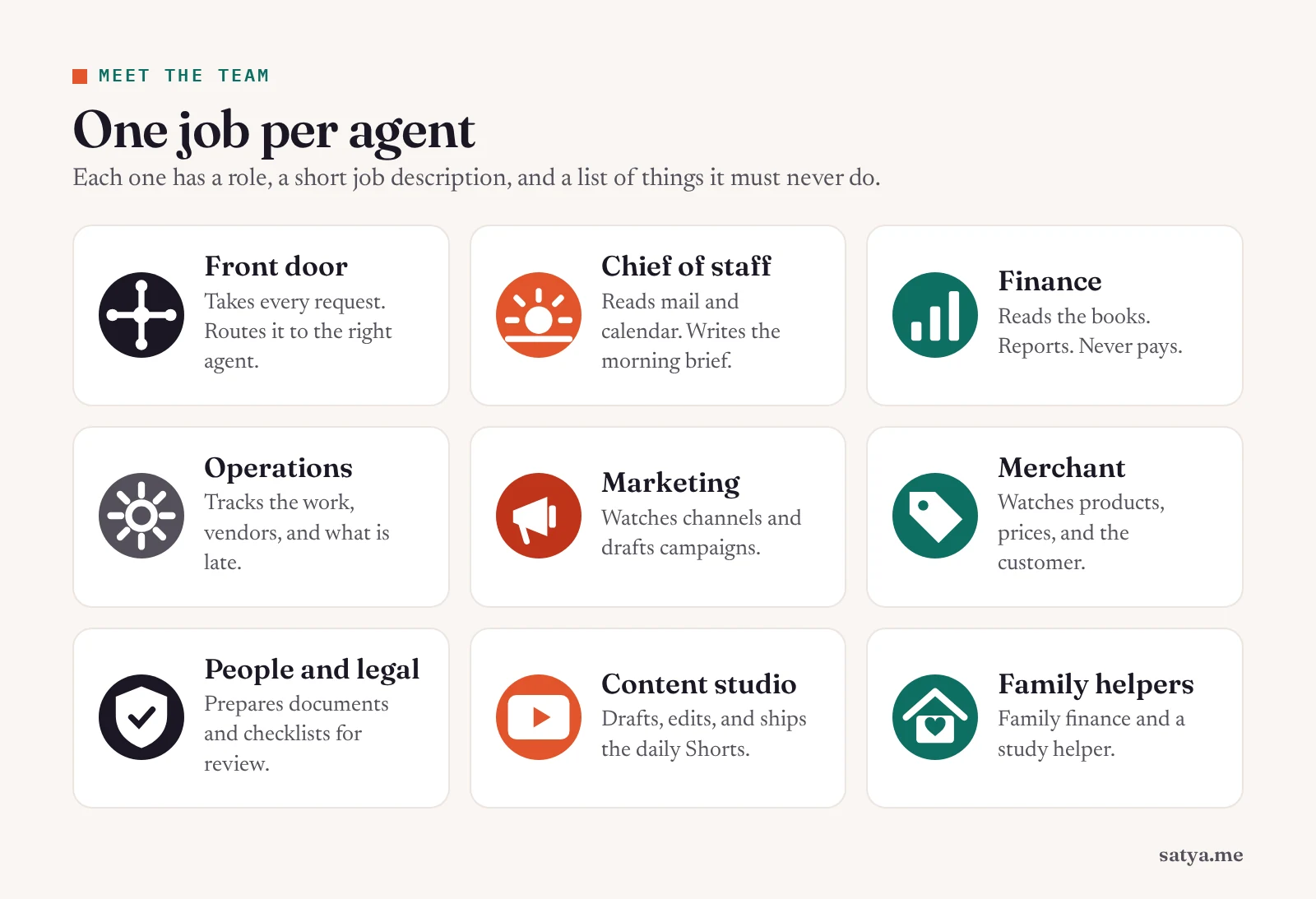 My AI team. Each agent has one job and an illustrated avatar, not a photo.
- A primary agent. The front door. It takes my requests and sends each one to the right teammate.
- A chief of staff. Reads my mail and calendar and writes a morning digest.
- Finance. Reads the books and the bank data. It reports. It does not pay.
- Operations. Tracks the work, the vendors, and what is late.
- Marketing and merchant. Look at channels, products, and the customer.
- People and legal. Prepare documents and checklists for me to review.
- A content studio. Writes, edits, and publishes two Shorts a day to YouTube, my site, and X, on a schedule I approved once.
- Personal helpers. A family finance helper, and a study helper for my family.
Every agent reports to the front door, not to me. I get one consolidated picture, not ten chats. This is the same rule I would set for a real leadership team. I wrote about why that matters in when alignment is the real bottleneck.
Why does one front door matter so much?
Because without it, I become the router. And a person who routes all day has no time left to decide.
With one front door, I say what I want in plain words. The primary agent figures out which teammate owns it, hands it over, and brings the answer back. If two agents need to work together, they talk through that front door too. Nobody is guessing who owns what.
What does the morning brief do?
It tells me what needs me today, and only that.
My chief of staff agent reads overnight mail and today's calendar. It sorts what is waiting on me from what is just noise. I start the day with a short list of things only I can decide, not a full inbox.
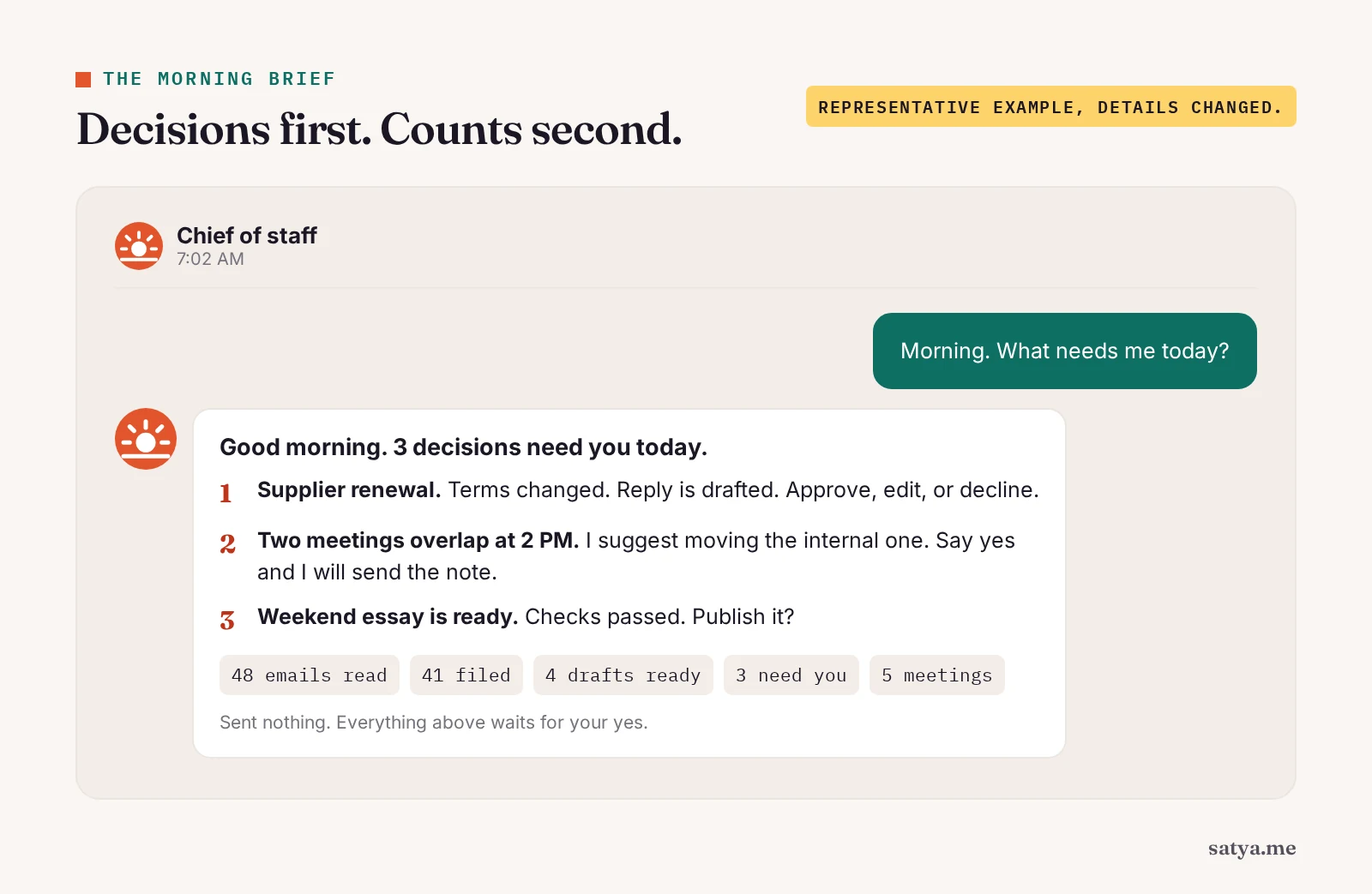 Representative example, details changed.
I made a short video about this: I only read the email that needs me.
What can an AI agent do alone, and what needs my yes?
This is the most important page in the whole setup. I call it the permission ladder.
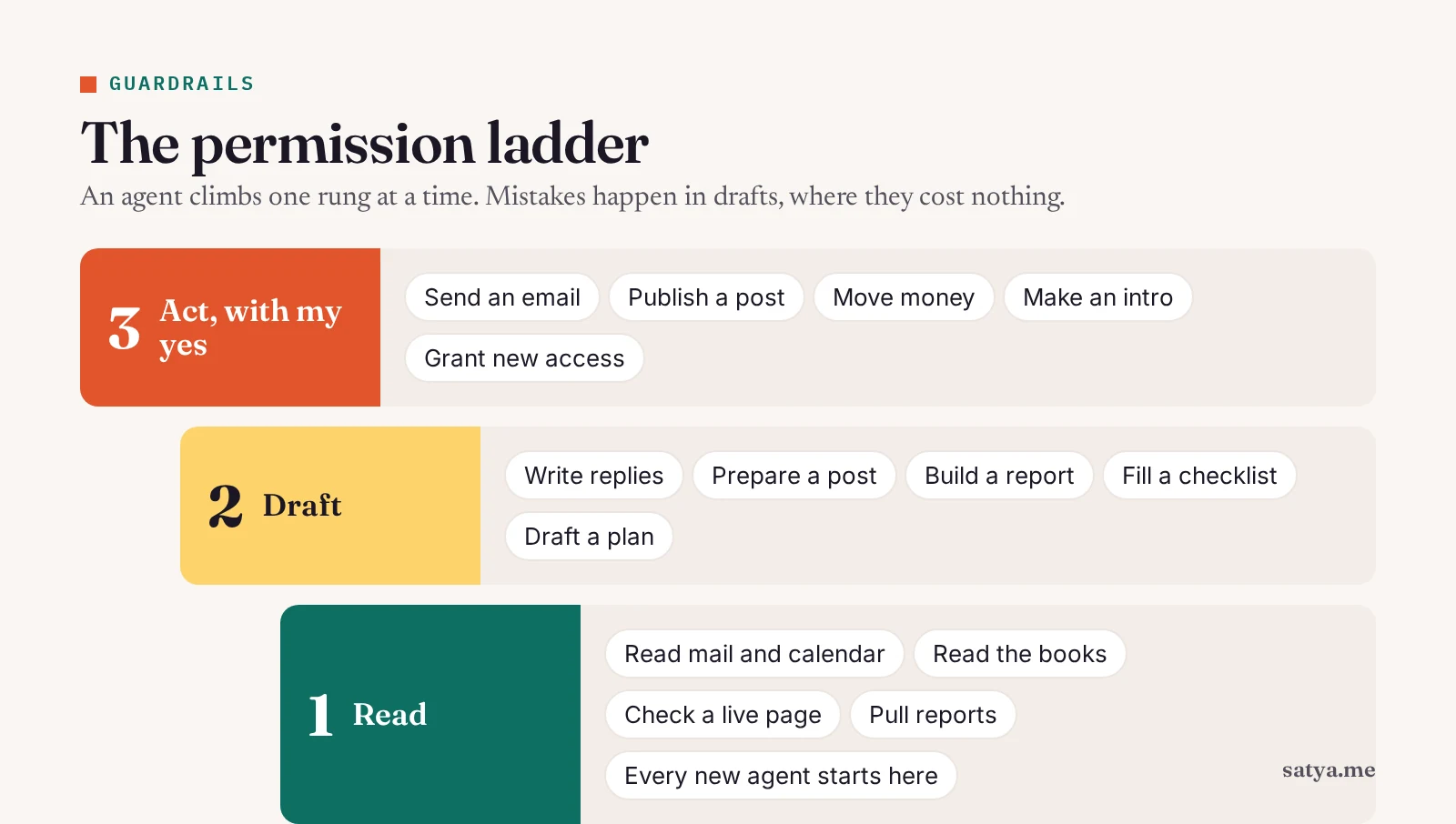 The permission ladder. Agents climb one rung at a time.
Step one: read. Every new agent starts read-only. It can look, but it cannot change anything. It gets edit access only when I grant it, for one system, on purpose.
Step two: draft. Agents can write anything. Emails, posts, documents, plans. A draft costs nothing and can be thrown away.
Step three: act, with my yes. Anything that leaves the building or cannot be undone waits for me:
- sending an email or a message in my name,
- publishing anything in public,
- moving money,
- making or accepting an introduction,
- giving an agent new access.
Some things I approve once, as a standing order. The two daily Shorts are an example. I approved the format and the schedule, so the studio runs it without asking each time. Everything else waits for a yes, every time.
This ladder is why I can trust the team. Not because the agents never make mistakes. They do. But a mistake in a draft is cheap, and the expensive steps always pass through a person.
Why does every answer say what was checked?
Because "done" is not a fact. "I opened the live page and it shows the post" is a fact.
My standing rule is that every report says what was checked against the real source, and what could not be checked. If an agent says a video is live, it has to say how it knows. If it could not open the page, it has to say so.
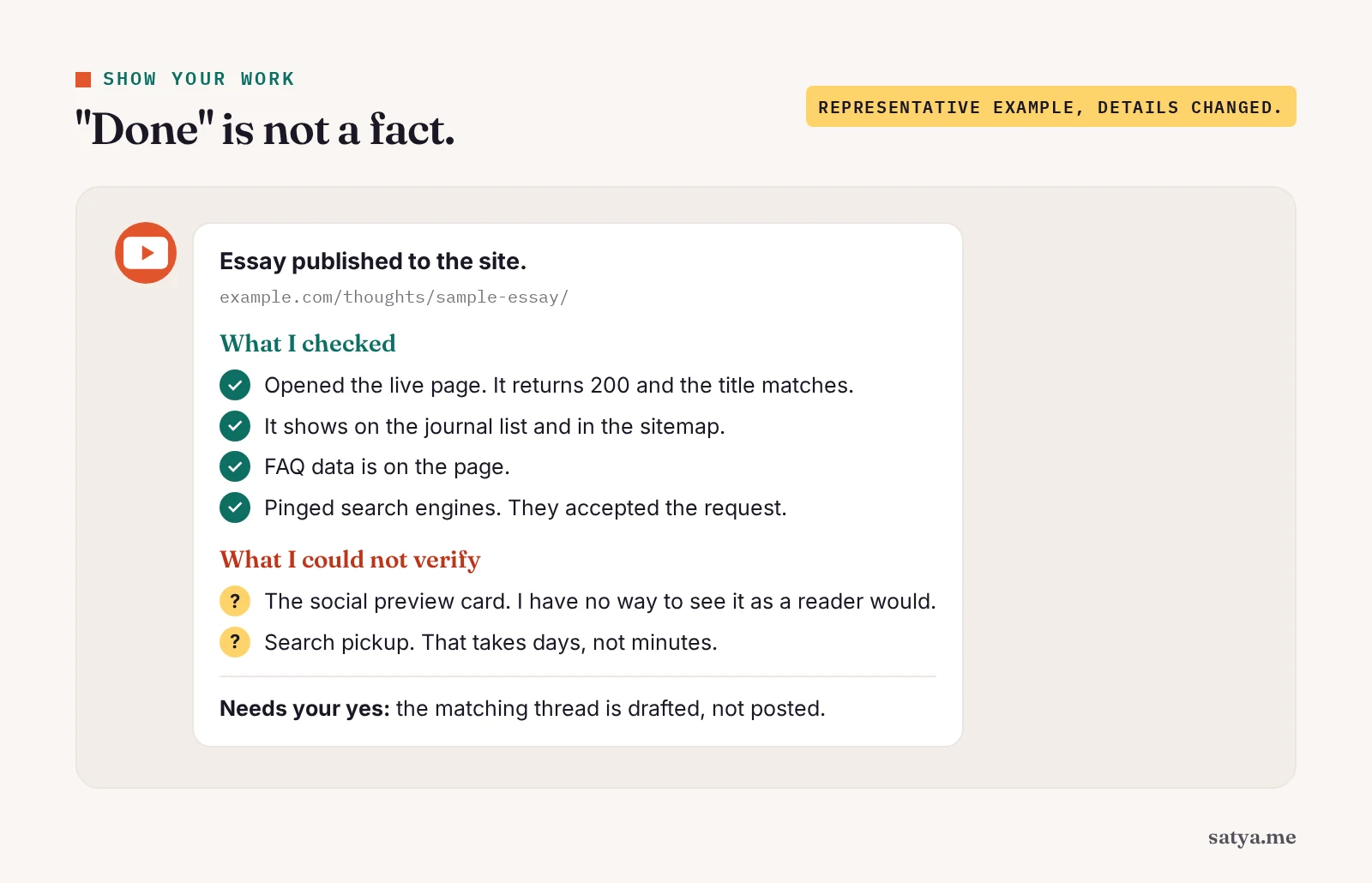 Representative example, details changed.
This one rule removed most of my worry. I don't have to wonder whether "posted" means posted. The report tells me.
How does the system get better?
When I correct the same thing twice, it becomes a written rule.
The first time, it is a correction. The second time, it is a pattern. So I write the fix into that agent's standing instructions, and every future run follows it.
A real example. I told the content studio that a Short on X must be the actual video, not just a link to YouTube. After that, it became a written step in the posting checklist, with a fallback and a rule to tell me if the fallback is used. I have not had to say it again.
Over time, those small rules add up to an operating manual. Not one I sat down to write. One the work wrote for me, one correction at a time.
How I use it with Claude and Grok CLI
The agent org runs the recurring work: the morning brief, the daily Shorts, the reports, and every approval. It is my operating team. When I want to build or fix something myself, I open a workbench. I have two.
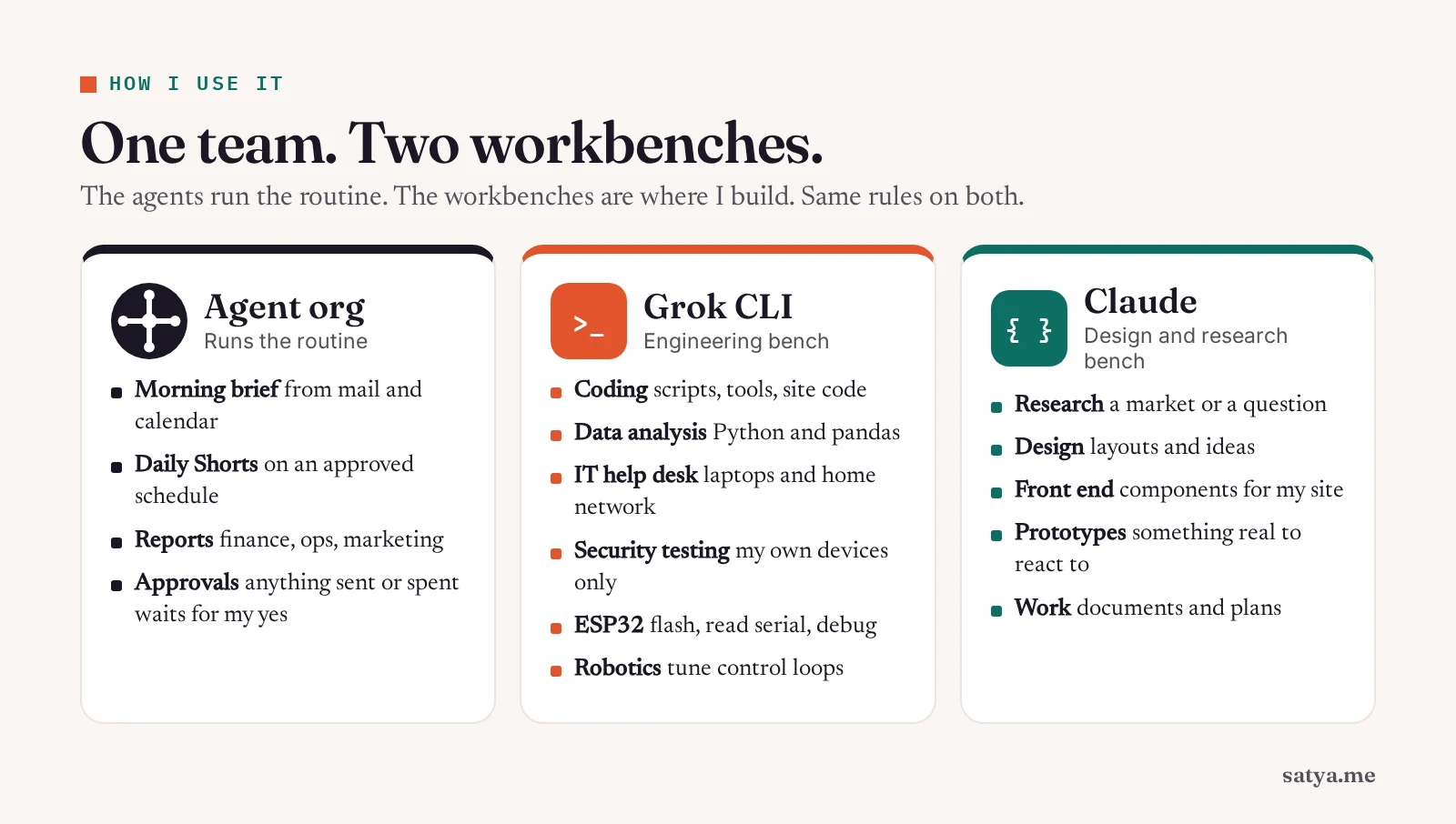 One team, two workbenches. The agents run the routine. I build at the bench.
Grok CLI is my engineering bench. I use it in the terminal for:
- Coding. Writing and fixing scripts, small tools, and site code.
- Data analysis. Loading a messy export into Python and pandas, then asking it simple questions.
- IT help desk. Working out why a laptop is slow or the home network keeps dropping.
- Fixing devices and ethical hacking. Security testing on my own devices and my own network, and nothing else.
- ESP32 coding. Flashing firmware, reading the serial log, and finding out why a board keeps rebooting.
- Robotics. Tuning a control loop for a motor or a sensor until the robot moves the way I expect.
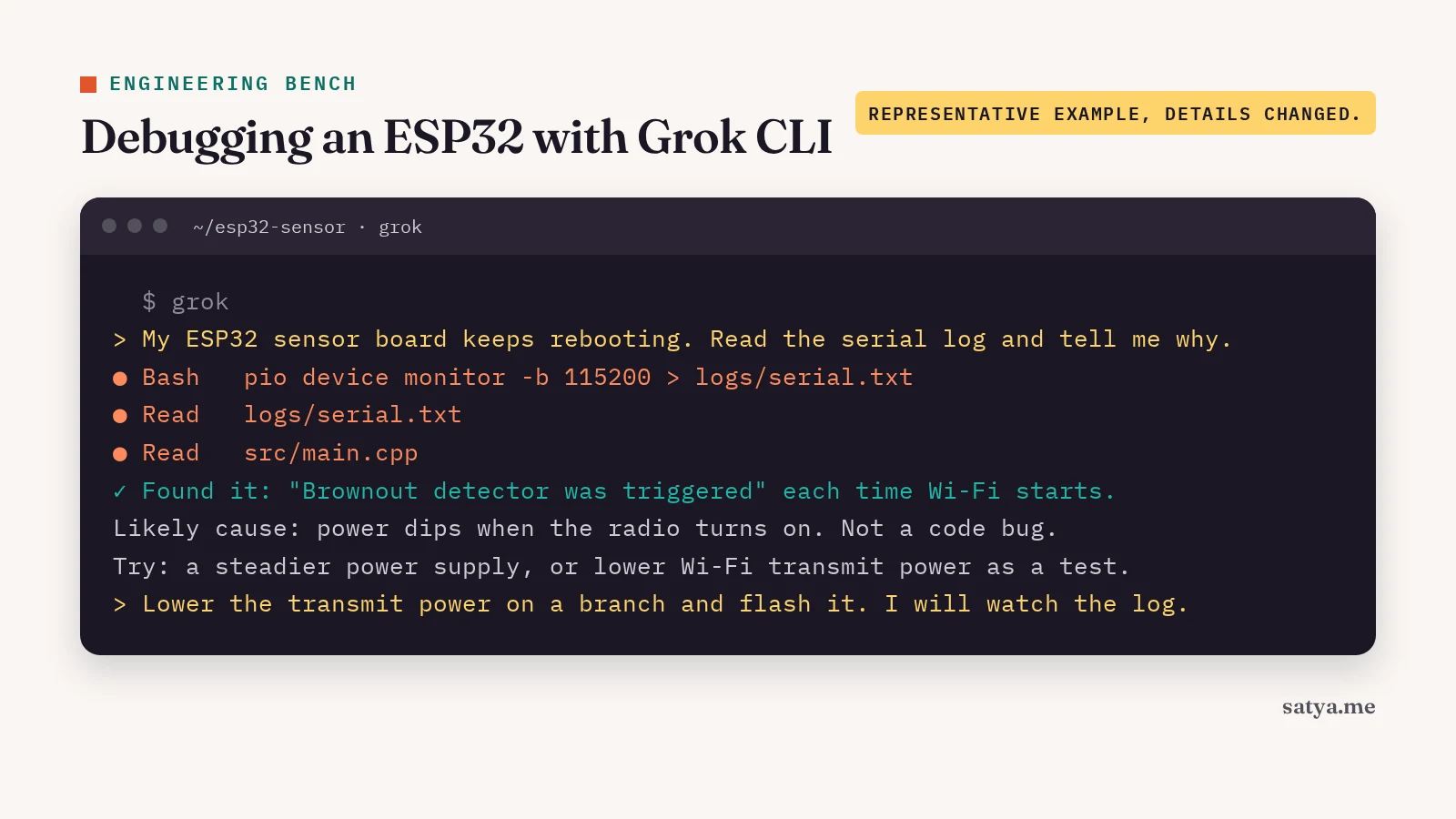 Representative example, details changed.
Claude is my design and research bench. I use it for:
- Research. Reading up on a market or a question before I form a view.
- Design. Exploring layouts and ideas before anything gets built.
- Front-end development. Building components and pages for my site.
- Prototypes. A quick working version of an idea, so I can react to something real.
- Work. Documents, plans, and first drafts.
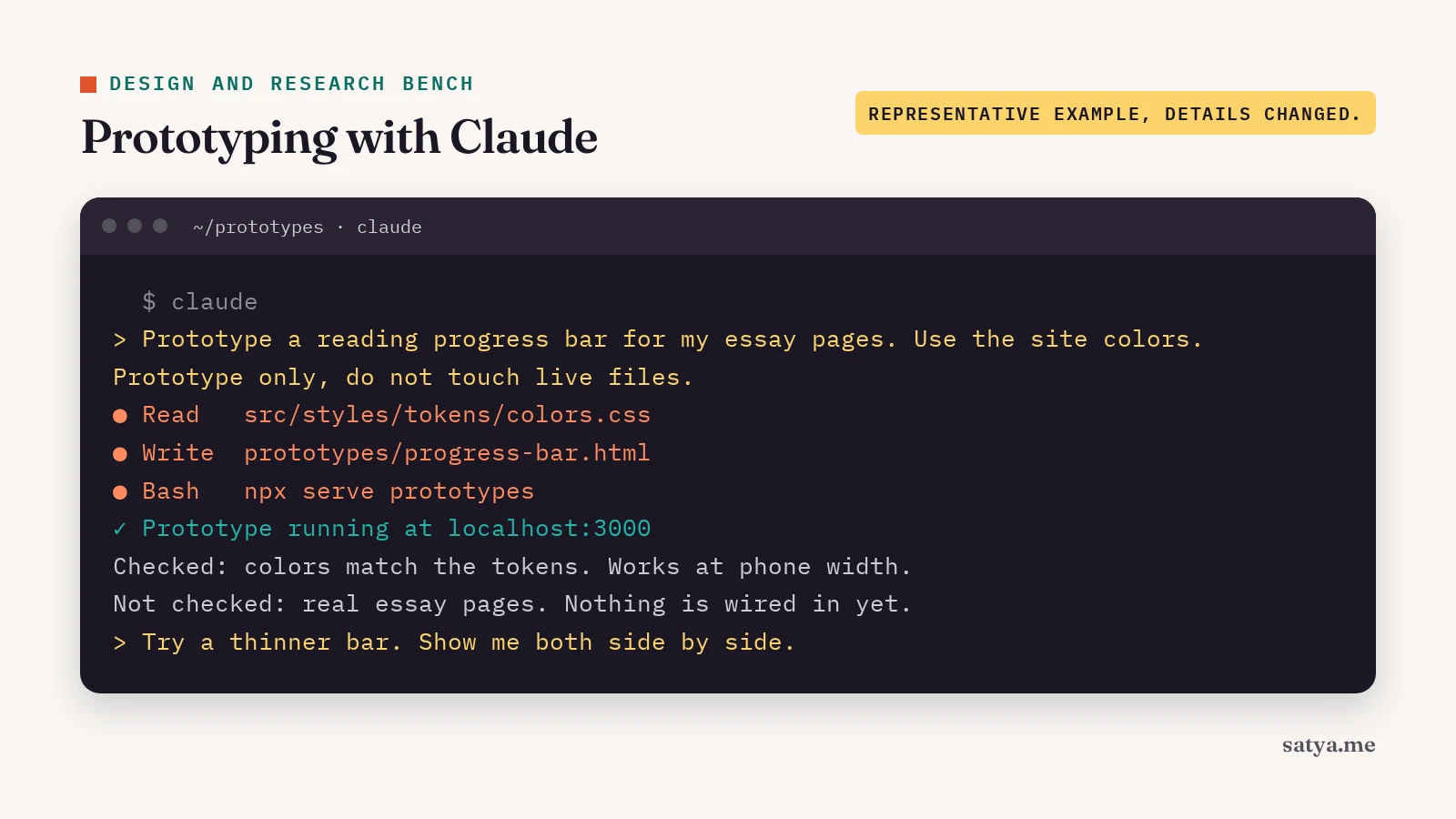 Representative example, details changed.
The same rules follow me to the bench. Each session shows what it checked. Nothing gets pushed, published, or sent without my yes. And when I fix the same thing twice, it becomes a rule there too.
The agents run the routine. The workbenches are where I make things.
What stays with me?
Judgment. People. Taste.
 The calls that stay with me get my full attention.
Which deal to chase. Who to trust. What to say no to. How a piece should feel before it goes out with my name on it. Agents can prepare every fact for those calls. They do not make them.
I also keep one more job: designing the org chart itself. Which roles exist, what each one may touch, and where the lines are. That is not admin work. It is the most leveraged work I do. I see the same thing in companies, which is why most AI pilots fail when nobody designs the structure around the tool.
How can you start your own AI org chart?
Start with one role, not ten.
- Hire a chief of staff first. One agent, one short brief each morning from your mail and calendar.
- Give it the ladder. Read-only first. Drafts are fine. Anything sent or spent waits for you.
- Make it show its checks. Every report says what it verified and what it could not.
- Write rules from repeats. Second correction, new rule.
- Add the next role only when the first one runs well for a few weeks.
I have not measured the hours this saves, so I won't give you a number. What I can tell you is that my mornings start with decisions, not sorting.
FAQ
What is an AI org chart? An AI org chart is a set of AI agents, each with one clear role, an owner, and written rules for what it may do alone. One agent routes the work, and a person keeps the judgment calls.
What should an AI agent be allowed to do without approval? Reading, sorting, summarizing, and drafting are fine. Anything that leaves the building or cannot be undone, like sending email, publishing, moving money, or making an introduction, should wait for a person's yes.
How do you make AI agents better over time? When you correct the same mistake twice, write the fix down as a standing rule in that agent's instructions. The next run follows the rule, so you stop correcting it.
How do Claude and Grok CLI fit with AI agents? In my setup, the agents run recurring work and approvals. Grok CLI is my hands-on bench for coding, data analysis, IT fixes, ESP32 firmware, robotics, and security testing on my own devices. Claude is my bench for research, design, front-end work, prototypes, and work documents.
How many AI agents should a small business start with? Start with one, usually a chief of staff agent that writes a short morning brief from your email and calendar. Add the next role only when the first one runs well for a few weeks.
One question for you
From designer to operator, I keep learning the same lesson: the system is the work.
If you staffed one AI agent tomorrow, what is the first job you would give it, and what would you never let it do without your yes?
Work with me
An operator's honest read for founders, owners, and CEOs. One sharp session, a full diagnosis, or a fractional seat.