Cash Is a Calendar, Not a Number
Your bank balance tells you how much cash you have today. It does not tell you if you can make payroll in six weeks. Here is how I run cash by the calendar.
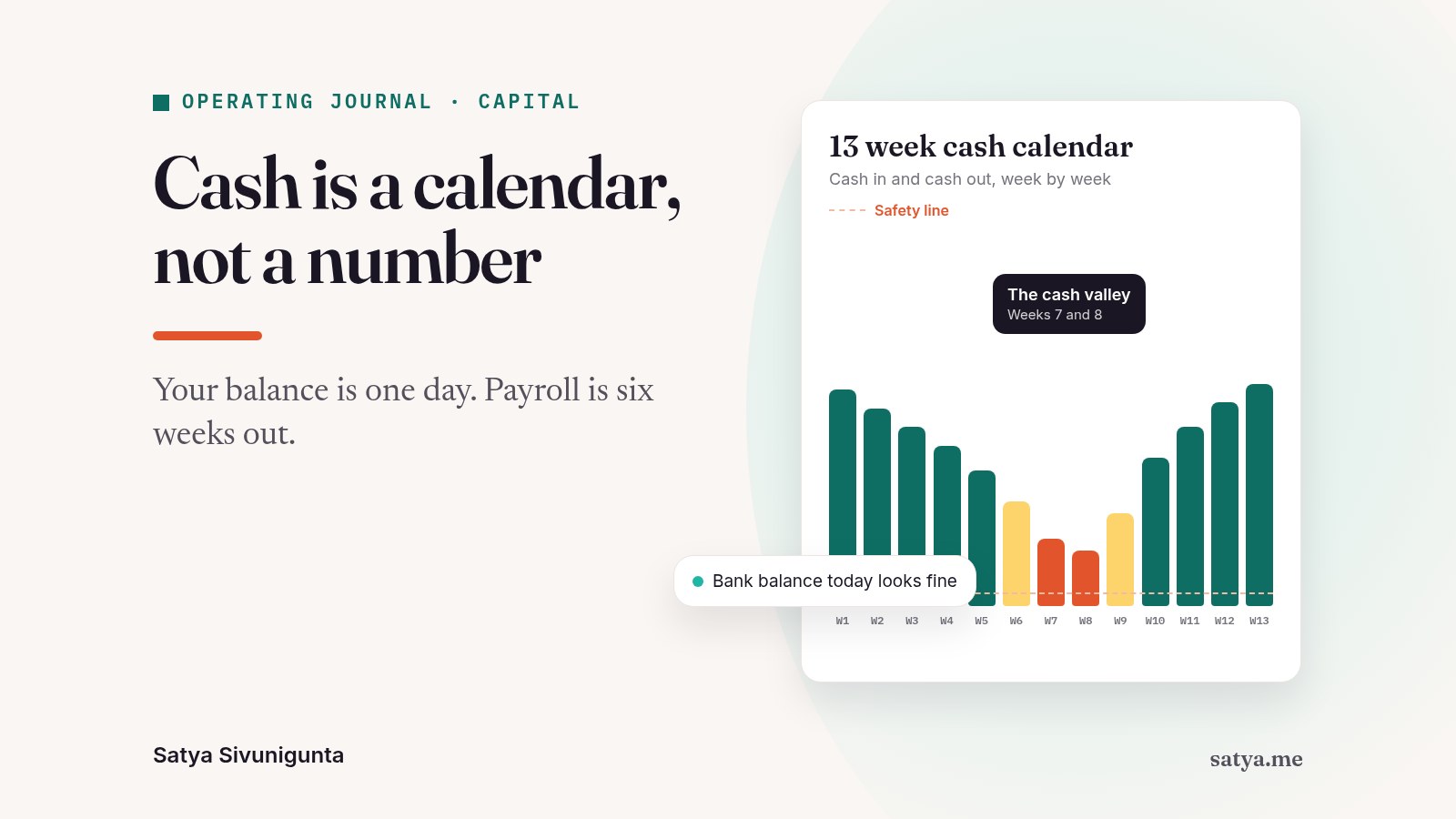
Ask most founders how much cash they have, and they will give you a number.
"About two million." "Four months of runway." "We are fine."
It is the wrong answer to the right question. Cash is not a number. Cash is a calendar.
I learned this slowly, and some of it the expensive way. This is how I think about cash now.
Key takeaways
- A bank balance is a photo of one day. A cash calendar is a movie of the next 13 weeks.
- Profit and cash arrive at different times. Growing companies run out of cash while making a profit.
- The median small business holds enough cash for 27 days of outflows. Retailers hold less.
- Read cash weekly, by date, line by line. Monthly is too late.
What does "cash is a calendar" mean?
It means you manage cash by when it moves, not by how much sits in the bank today. The question is not "how much do we have?" The question is "on which day does it get tight, and what can we do before then?"
Think about a normal month in a consumer business.
Payroll goes out every two weeks. Rent goes out on the first. A big inventory order needs a deposit now, and the rest when it ships. Ad spend hits the card every few days. Taxes come due on a fixed date.
Money comes in on a different rhythm. Card payments settle in a day or two. Marketplaces pay out on their own schedule. Wholesale customers pay in 30, 60, or 90 days, if they pay on time.
Put those two rhythms on a calendar, and you see what the balance hides. You can have plenty of cash on the 1st and be short on the 15th.
Why can a profitable company run out of cash?
Because you pay for growth before growth pays you. Profit is an accounting idea. Cash is a timing idea.
Say you sell a product with good margins. Demand is rising. So you order more inventory for the holidays. You pay the supplier in summer. The product sits on the water, then in a warehouse. Customers buy it in November. Some pay with terms. Some return it in January.
On paper, the season is profitable. In the bank, July through October is a valley.
I made a short video about falling in love with the wrong number. The revenue trap: we got bigger, we did not get richer. Cash is where that trap shows up first.
How many days of cash does a typical small business have?
Less than a month, for half of them.
The JPMorgan Chase Institute studied the bank accounts of about 597,000 small businesses. The median business held enough cash to cover 27 days of its normal outflows if all income stopped. One in four held fewer than 13 days. The median retailer held 19 days. The median restaurant held 16.
The data is from 2015, so treat it as a pattern, not a current number. But the pattern matches what I have seen inside companies of every size.
Newer data says the same thing in another way. In the Federal Reserve's 2026 Report on Employer Firms, half of small employer firms (50%) named uneven cash flow as a financial challenge in the prior 12 months. Even more, 54%, said paying operating expenses was a challenge. The same report found 56% of firms that applied for financing did it to meet operating expenses.
That is not a profit problem. That is a calendar problem.
Why is a bank balance the wrong way to read cash?
Because a balance looks backward and a calendar looks forward. The balance tells you what already happened. It is silent about the payroll in two weeks.
I made this mistake with numbers in general. I used to read them monthly. By the time the monthly report came, the month was already gone. I talk about it in CEO mistake 3. Weekly is how you catch a miss while you can still fix it.
Cash is the number where this matters most. A sales miss shows up in cash a few weeks later. A supplier who changes terms shows up right away. A late customer payment can turn a fine month into a scary one.
I also watched what happens when there is no room for timing to be wrong. At Art Van, private equity debt and a sale-leaseback left no room to be wrong. I wrote about it in I worked at three retailers that went bankrupt. The fixed payments did not move. Everything else did.
How do you build a 13-week cash calendar?
Make a simple sheet with 13 columns, one per week. Rows for every kind of cash in and cash out. Update it every week, and compare the plan to what really happened.
Here is how I set it up.
1. Start with today's real balance. From the bank, not from the books.
2. List cash in by week. Card settlements, marketplace payouts, wholesale receipts, anything else. Use the date the money lands, not the date of the sale.
3. List cash out by week. Payroll, rent, inventory deposits and balances, freight, ad spend, software, loan payments, taxes. Use the date the money leaves.
4. Find the lowest week. That is your real cash position. Not today's balance. The low point.
5. Set a floor. Decide the minimum cash you never go below. Any week that dips under the floor turns red.
6. Plan the levers for red weeks. Move a purchase order. Ask a supplier for different terms. Slow an ad test. Collect a late invoice. Draw on a line of credit early, not in panic.
7. Every week, compare plan to actual. Where were you wrong? Why? Each miss makes the next forecast better.
Thirteen weeks is about one quarter. It is long enough to see a problem coming and short enough to be accurate. I have said before that a CEO who does not personally watch the 13-week cash flow is one bad quarter from the brink. I wrote that in EBITDA is a moral document. I still believe it.
Who should own the cash calendar?
Finance builds it. The CEO reads it every week. The operating leaders feed it.
This is the part most teams miss. Cash is not only a finance job. The person who places the inventory order controls a big cash line. So does the person who sets the ad budget. So does the person who negotiates supplier terms.
When those leaders see the calendar every week, they start to make better choices on their own. "If I move this order two weeks, the red week turns green." That is the moment the team starts thinking like owners.
What changes when you run cash by the calendar?
You stop being surprised. And surprise is what forces bad decisions.
Most bad cash decisions are made in a hurry. A discount to pull sales forward. A loan with ugly terms. A layoff that did not need to happen. I know the discount one well. I talk about it in CEO mistake 2. Fear pricing feels like a win in the week and trains the customer to wait.
When you can see the low point eight weeks out, you have time. Time is the most valuable thing a cash calendar gives you.
There is a dharma idea here that I hold onto. Do the work in front of you, in the right order, without panic about the result. A cash calendar is just that. Today's job is this week's column. You do it well, and the quarter takes care of itself.
FAQ
What does "cash is a calendar" mean? It means cash should be managed by date, not by balance. What matters is when money comes in and when it goes out, week by week, so you can see a shortfall before it arrives.
What is a 13-week cash flow forecast? It is a week-by-week plan of expected cash in and cash out for the next 13 weeks, about one quarter. You update it every week and compare it to what really happened.
How many days of cash does a typical small business hold? A JPMorgan Chase Institute study of about 597,000 small businesses found the median held enough cash to cover 27 days of normal outflows. Retailers held a median of 19 days.
Why can a profitable company run out of cash? Because profit and cash arrive at different times. You often pay for inventory, payroll, and ads weeks or months before the customer pays you, so a growing, profitable business can still hit a cash gap.
One question for you
Open your bank app and look at the balance. Now tell me: which week in the next quarter is your lowest, and what will you do about it?
Work with me
An operator's honest read for founders, owners, and CEOs. One sharp session, a full diagnosis, or a fractional seat.