Build the Record. Rent the Plumbing.
Software for our customer record and CRM would have cost about $150,000 a year. We built them for $30,000 to $40,000 once, plus upkeep. Here is the test I use.
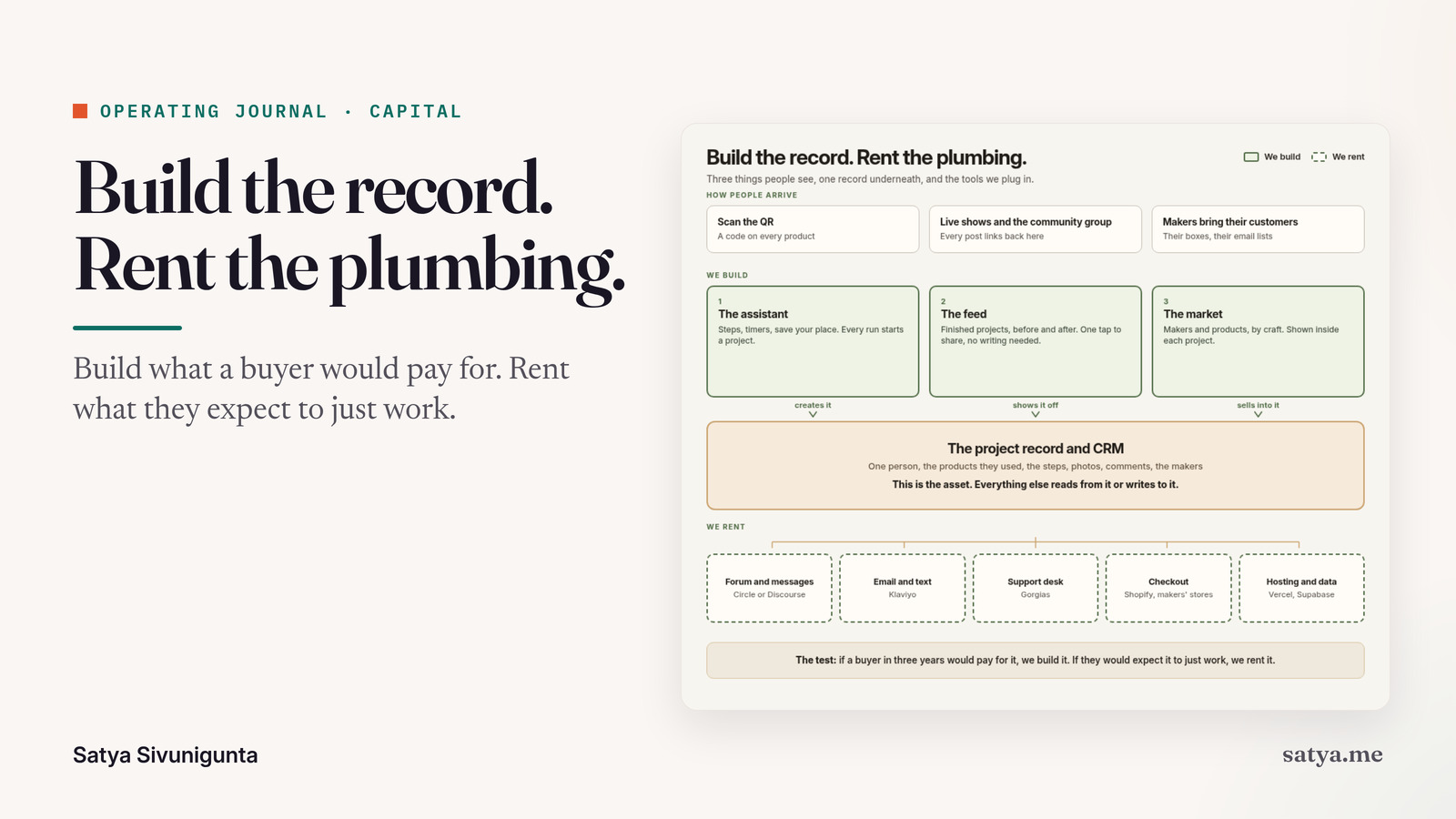
I'm saving over $100,000 a year with one test.
If a buyer showed up in three years, would they pay for this, or would they expect it to just work?
If they would pay for it, we build it. If they would expect it to just work, we rent it.
We call the first thing the record. We call the second thing the plumbing.
The short answer: Software for our customer record and CRM would have cost about $150,000 a year. We built both for $30,000 to $40,000 once, plus upkeep. We still rent the forum, email, support, checkout, and hosting. Build what a buyer would pay for. Rent what they expect to just work. The system is the work.
Key takeaways
- Use the buyer test on every build. If a buyer would pay for it, build it. If they would expect it to just work, rent it.
- The project record and the CRM are the asset. They are how you own the customer.
- Forum, email, support, checkout, and hosting are plumbing. Renting them is cheap and fast.
- The math: about $150,000 a year to rent, or $30,000 to $40,000 once to build, plus upkeep.
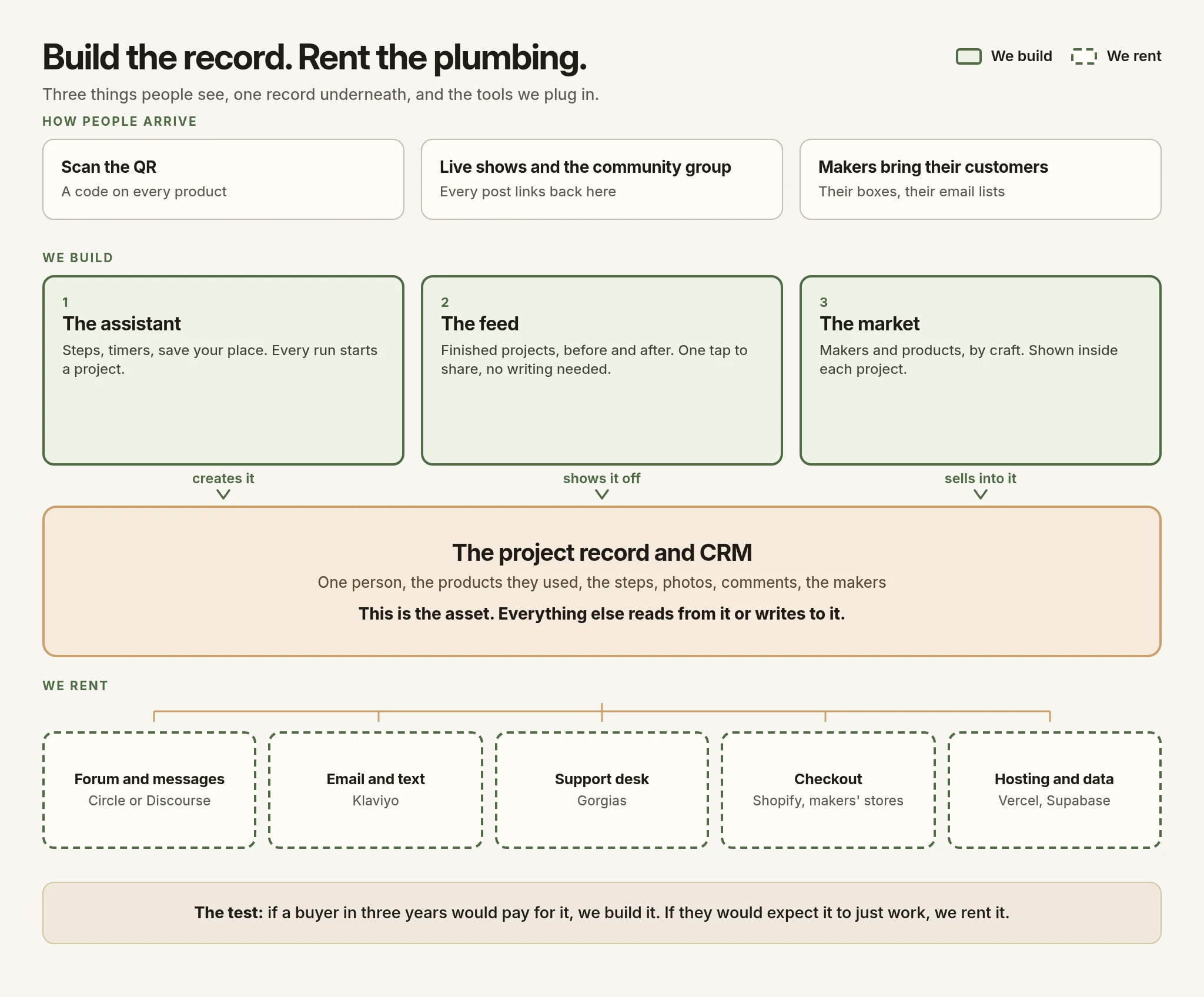 Build the record. Rent the plumbing. If a buyer would pay for it, we build it. If they would expect it to just work, we rent it.
What is the project record?
It is one living file for each person's work.
I am doing this now with a Made in America home brand. People arrive in three ways. They scan a code on a product. They come from our host's live shows. Or a maker brings their own customers.
Once they are in, they need help finishing a project. They want to show what they made. They want to find the next product or the next maker.
All of that should live in one place:
- One person
- The products they used
- The steps they took
- The photos
- The comments
- The makers who helped
That is the project record. If a buyer showed up in three years, this is the part they would pay for. Not because it is fancy software. Because it is the memory of the customer.
What do we build, and why?
We build the record and the CRM. Then we build three things on top of them.
The record and the CRM. Who the person is, what they bought, what they made, and how we talk to them. This is owning the customer. We do not want to rent that.
1. The assistant. Steps. Timers. A way to save your place. This is the promise: we will walk with you until the project is done.
2. The feed. Finished projects. Before and after. One tap to share. This is how one person's work becomes proof for the next person.
3. The market. Makers and products, grouped by craft. This is how the next project starts.
All three read from the record and write back to it. No rented tool knows our craft, our steps, or our people. I wrote about this idea in a wider way in the system is the work. The screen is still the smallest part. The record is the system.
What do we rent, and why?
We rent the plumbing.
- Forum and messages: Circle or Discourse
- Email and text: Klaviyo
- Support desk: Gorgias
- Checkout: Shopify, and the makers' own stores
- Hosting and data: Vercel and Supabase
A buyer would not pay extra for our own version of these. They would expect them to just work, the way they expect lights to turn on in a building.
Renting them is cheap and fast. If we built them, we would own the bugs, the uptime, the spam, and the payment risk. That is not an asset. That is a second company.
How does the buyer test work?
I use it on every request to "just build it." Write the thing on a card. Then ask two questions.
- In three years, would a buyer pay for this?
- Or would they assume it already works?
If the answer is one, we build it, and it lives in the record. If the answer is two, we rent it, and we make sure it writes back to the record.
The record has to stay ours. The pipes can change. We can switch a forum or a help desk later. We cannot rebuild a customer history that lives in five tools and in no one's system.
Where does the $100,000 come from?
From building the record and the CRM ourselves, instead of buying software for them.
Here is the math, plainly. The software would have cost about $150,000 a year. That is a yearly fee, every year. Building our own cost $30,000 to $40,000 one time, plus upkeep. The gap is over $100,000 a year.
The rented plumbing is not where the saving comes from. Those tools are already cheap. The saving comes from not paying a yearly fee to rent the one thing a buyer would pay us for.
There is a general shift behind this. AI tools have made custom software much cheaper to build than it was a few years ago. So the old rule, "always buy, never build," deserves a second look. Not for everything. Only for the part that is truly yours.
What should an operator copy?
You do not need my stack. You need the test.
Make a two-column list of your software. In the first column, write what a buyer would pay for. In the second, write what they would expect to just work.
Then look at what you pay each year for the first column. Many companies rent their most valuable thing and custom-build their plumbing. That is backwards.
Own the customer record. Let the pipes be pipes.
From designer to operator, I keep learning the same lesson. The system is the work. In this case, the record is the system.
FAQ
What is a project record? It is one living file for each person's work. It holds the person, the products they used, the steps they took, the photos, the comments, and the makers. That record is the asset.
What is the buyer test for build versus rent? Ask if a buyer in three years would pay for this, or would expect it to just work. If they would pay for it, build it. If they would expect it to just work, rent it.
Why build the CRM instead of buying it? Because the CRM is part of owning the customer and the project record. A buyer would pay for that. And for us, the software would have cost about $150,000 a year, while building it cost $30,000 to $40,000 once, plus upkeep.
Why rent the forum, email, support, checkout, and hosting? Because a buyer expects those to just work. Renting them is cheap and fast, and a good rented tool already does the job.
One question for you
What are you paying for every year that a buyer would expect you to own?
Work with me
An operator's honest read for founders, owners, and CEOs. One sharp session, a full diagnosis, or a fractional seat.