Agentic Commerce: Customers Now Shop Through AI Agents
Shoppers now ask AI agents what to buy, and sometimes the agent buys it. Here is what agentic commerce means for your store, and what I would fix first.
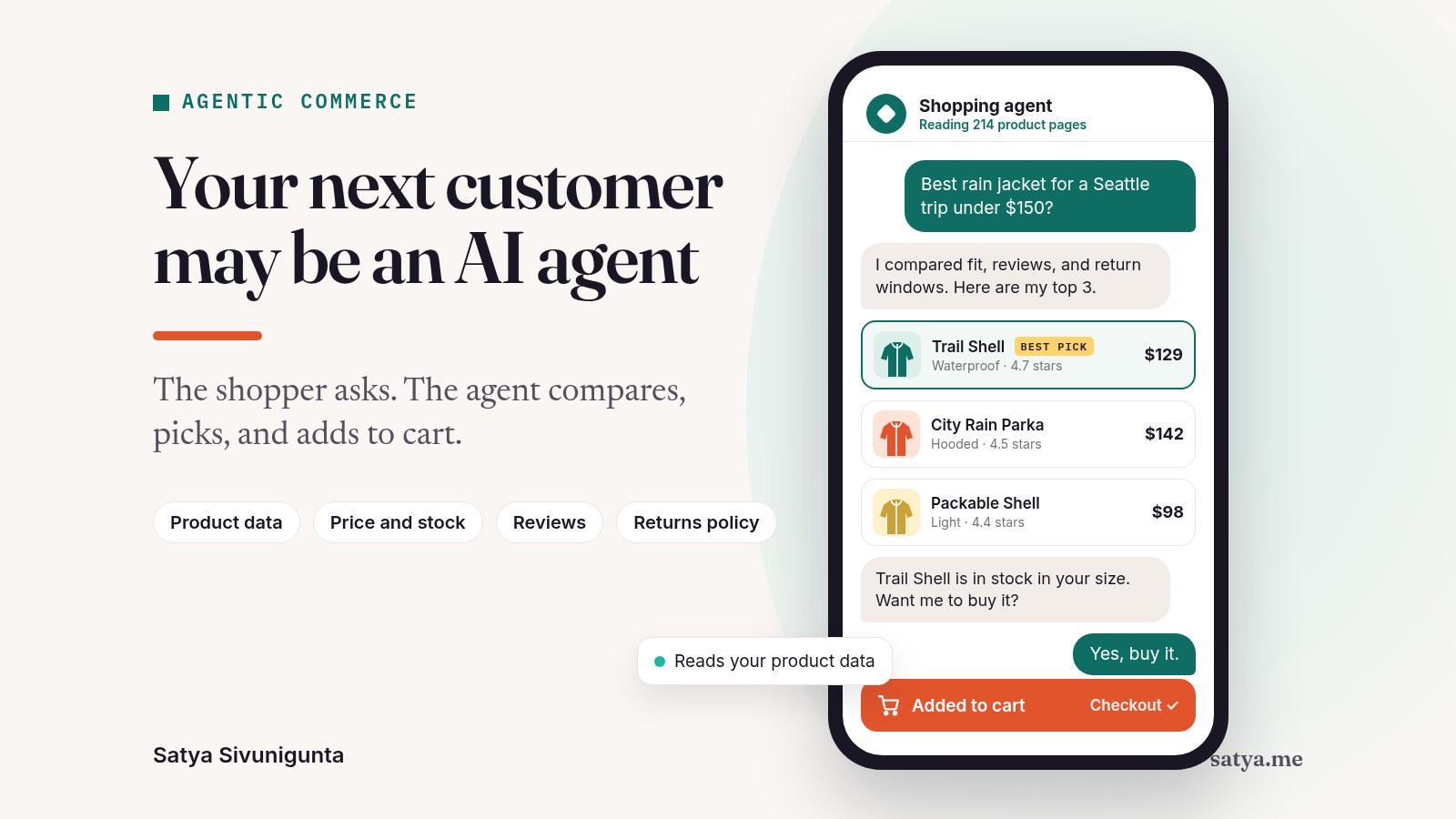
A shopper used to start on your homepage, or on a search results page.
Now a lot of them start with a question typed into an AI tool. "Best rain jacket for a trip to Seattle under $150." The AI reads the web, picks a few products, and explains why.
Sometimes the shopper never visits your site at all.
I spent years building ecommerce for large retailers. We obsessed over the storefront: the homepage, the product page, the checkout. That work still matters. But the storefront is no longer the only front door.
Key takeaways
- Agentic commerce means an AI agent helps the customer find, compare, and sometimes buy. Your product data is now your shelf.
- The traffic is still small, but it is growing fast. Adobe saw AI referral traffic to US retail sites rise almost 700% in the 2025 holidays.
- The big platforms are building open protocols so agents can check out. The merchant stays the merchant of record.
- The first fix is boring and powerful: complete, accurate, structured product data and clear policies.
What is agentic commerce?
Agentic commerce is when an AI agent shops on behalf of a person. It searches, compares, answers questions, and in some cases completes the purchase.
McKinsey describes a few ways this can work. An agent can visit your site. An agent can talk to your own agent. Or a platform can sit in the middle and broker the visit. In every version, a machine stands between you and the customer for part of the journey.
That changes who you are designing for. For twenty years we designed for a human eye. Now we also design for a machine that reads.
How fast is AI shopping growing?
It is growing very fast from a small base. That is the honest way to say it.
Adobe reported that traffic to US retail sites from generative AI tools rose 693.4% year over year in the 2025 holiday season, from November 1 to December 31. On Cyber Monday it rose 670%. Adobe also said the base of users "remains modest."
So do not panic. But do not wait either.
The same McKinsey report says half of all consumers now use AI when they search the internet, and 44% of people who use AI search call it their primary and preferred source. McKinsey estimates that agentic commerce could orchestrate $900 billion to $1 trillion of US retail revenue by 2030.
That is an estimate, not a fact. But when a growth curve is this steep, the time to prepare is before it matters.
Can customers actually buy inside an AI chat?
Yes, in some places, and the rules are still being written.
In September 2025, OpenAI launched Instant Checkout in ChatGPT, built on a new open standard called the Agentic Commerce Protocol, made with Stripe. OpenAI said more than 700 million people turn to ChatGPT each week. The first sellers were US Etsy sellers, with Shopify merchants to follow. The merchant handles orders, payments, and fulfillment, and stays the merchant of record.
In January 2026, Google launched the Universal Commerce Protocol, co-developed with Shopify, Etsy, Wayfair, Target, and Walmart. It powers a checkout inside Google's AI Mode and the Gemini app. Google says retailers remain the seller of record.
Then a useful twist. In March 2026, InternetRetailing reported that OpenAI was pulling back from Instant Checkout. OpenAI said the first version "did not offer the level of flexibility" it wanted. Merchants would use their own checkout, and ChatGPT would focus on discovery.
What do I take from this? The checkout part is still unsettled. The discovery part is not. Agents are already choosing which products a shopper sees. That is where I would put my energy first.
Why does product data matter more than the storefront now?
Because the agent cannot see your beautiful photos the way a person does. It reads your data. If your data is thin, the agent has nothing to recommend.
McKinsey says product catalogs will need richer "semantic and behavioral metadata." Google said the same thing in plain words when it announced dozens of new data attributes in Merchant Center. They go beyond keywords to include answers to common product questions, compatible accessories, and substitutes.
Think about what a good store associate knows. Does this fit true to size? Will it work with my old model? What do people return it for? Is it in stock near me?
That knowledge used to live in the associate's head, or in reviews, or nowhere. An agent needs it written down, structured, and accurate.
I learned this the hard way long before AI. A promise on the screen is only as good as the operation behind it. I wrote about that in one brand, three surfaces. An AI agent is just one more surface. It is a very honest one. It repeats whatever your data says.
What would I fix first to get ready for AI shopping agents?
I would fix the boring things, in this order. Data first, then policies, then measurement, then the checkout.
1. Complete the product data. Every product gets full attributes: size, material, use, fit, compatibility, care. Then add the questions customers really ask, with real answers. Your customer service inbox is a gold mine for these.
2. Make price and stock true in real time. An agent that recommends a product that is out of stock, or at the wrong price, will learn to trust you less. So will the customer.
3. Write your policies so a machine can read them. Shipping times, return windows, warranty. Plain words, one place, no fine print games. An agent compares these side by side, faster than any shopper. Returns are a profit issue already, as I wrote in the return loss. They are now a ranking issue too.
4. Measure AI traffic on its own. Split out visits that come from AI tools in your analytics. Watch conversion, basket size, and returns for that group. Do not mix it into "other."
5. Then decide on checkout. Should you let customers buy inside an AI tool, or send them to your site? There is no single right answer yet. The protocols are open and moving. Decide with your own numbers, not with fear.
Will AI agents take my customer relationship away?
They can, if you let them. Both big protocols say the merchant stays the merchant of record. That is good. But being the merchant of record is not the same as being the brand the customer remembers.
The customer remembers who delivered on time, who made the return easy, who answered the question honestly. That part is still yours to earn.
This is why I keep saying that loyalty is built in operations, not in a points program. I wrote about it in loyalty is not a program, it is an operating system. Agents make that more true, not less. When a machine compares you to everyone else in one second, the only thing that stands out is a real promise kept.
There is also a cost side to watch. Every new channel becomes a toll road over time. I wrote about Amazon building a second ad tax on AI. The same pattern can happen here. Today discovery in AI tools is mostly organic. Plan for the day it is not.
Where should a team start this week?
Pick your top 20 products by revenue. Ask three AI tools the questions your customers ask about them. Read the answers.
Are your products there? Are the facts right? Is a competitor recommended because their page answers the question and yours does not?
That one hour will tell you more than any report. And it is free.
Behind all of this is one idea I keep coming back to. Satya means truth. An agent can only tell the truth about your products if you give it the truth first.
If your data is a mess because your tools do not talk to each other, start there. I wrote about 11 tools and no single view of the customer and why I fixed the data before anything else.
FAQ
What is agentic commerce? Agentic commerce is when an AI agent helps a shopper find, compare, and sometimes buy a product on their behalf, inside a chat or AI search tool instead of on the brand's own site.
How do AI shopping agents decide which products to show? They read product data, reviews, prices, stock, and policies from feeds and websites. Clear, complete, structured product data makes a product easier for an agent to understand and recommend.
Do I lose the customer if they buy through ChatGPT or Gemini? Not by design. Both OpenAI's Agentic Commerce Protocol and Google's Universal Commerce Protocol say the merchant stays the merchant or seller of record, but you must still earn the repeat visit.
What should a retailer do first to get ready for AI agents? Fix product data first. Complete attributes, answer common questions, and make sure price, stock, shipping, and return policies are accurate and easy to read.
One question for you
If an AI agent read your product pages today, what would it get wrong about you?
Work with me
An operator's honest read for founders, owners, and CEOs. One sharp session, a full diagnosis, or a fractional seat.